April 23, 2026

The first quarter of 2026 can be divided neatly into two distinct periods: the first two months, when global equities advanced strongly lead by international markets, and March, when the Iran war triggered a sharp correction, and US assets outperformed. March was not kind to European equities, given the region’s high economic sensitivity to energy prices. The European Index posted its largest monthly decline in March since June 2022, erasing the strong gains of the earlier months and finishing the quarter with a decline of almost -2%.
Commodities were the clear winners of Q1 with the main commodity indices posting a +40% return lead by energy. It was the second-best quarter on record for the asset class after Q1 1990, at the start of the first Gulf War.
The dominant role of government policy and geopolitics
The last three months were an accurate reflection of how government policy plays a large role in influencing the shorter-term trends in financial markets. Last quarter, the US engaged in two military ‘excursions’ targeting China’s proxies (Venezuela and Iran), the Strait of Hormuz shut down, oil prices spoked, the Supreme Court threw out Trump’s global tariffs, Trump selected a new Federal Reserve Chair while the current Fed Chair still faces a criminal probe. All this within the corporate context of AI disrupting every industry and starting to impact negatively on private credit markets as the survival of certain industries are brought into question.
Given these events, it is no wonder that investor enthusiasm for risk taking, which was extended as equity markets rallied in the beginning of the year, cooled considerably by quarter end. We are reminded of the quote ascribed to a US author and news reporter:
“The biggest big business in America is not steel, automobiles, or television. It is the manufacture, refinement, and distribution of anxiety.”
This was uttered over 70 years ago and is even more relevant now given the 24-hour streaming social media noise.
Fastest recovery in 75 years
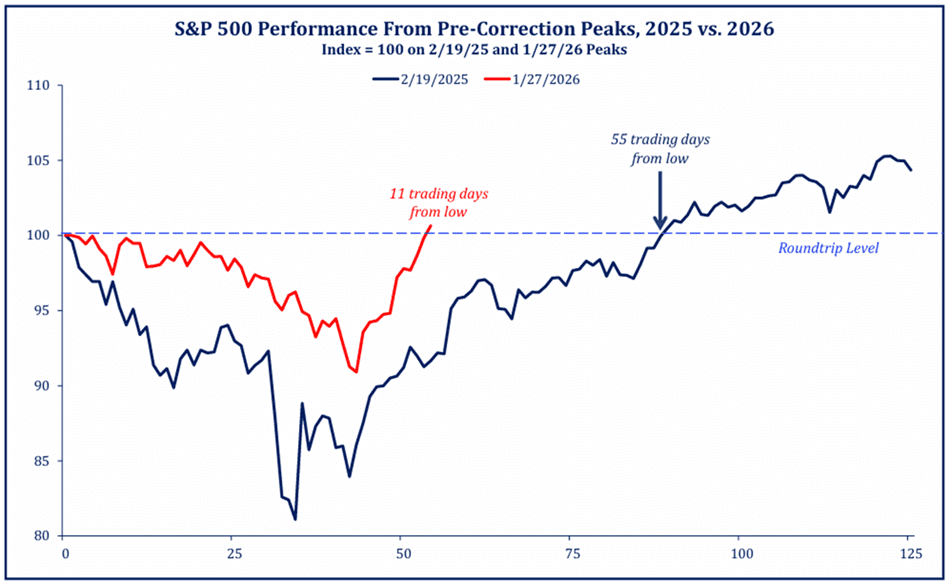
At the time of writing, global equity markets have already erased the March decline and are back in positive territory for the year. The US market reclaimed its high in just eleven trading days (chart below) - the fastest recovery in 75 years following a correction of at least 8%. Such strong recoveries, though suggesting overbought conditions in the short-term, historically signal above average market returns in the medium-term.
Source: Strategas Research Partners
We have often warned of the dangers of being influenced too much by the dramatic headlines of the financial press.
Financial markets remain resilient. Corporate profits so far have been decent and, in some regions, have even increased since the war commenced. Despite building concerns in the private credit market and modest spread widening, credit has not been a broad concern. With earnings and interest rates holding up their end of the bargain, it is tough to get too pessimistic as yet.
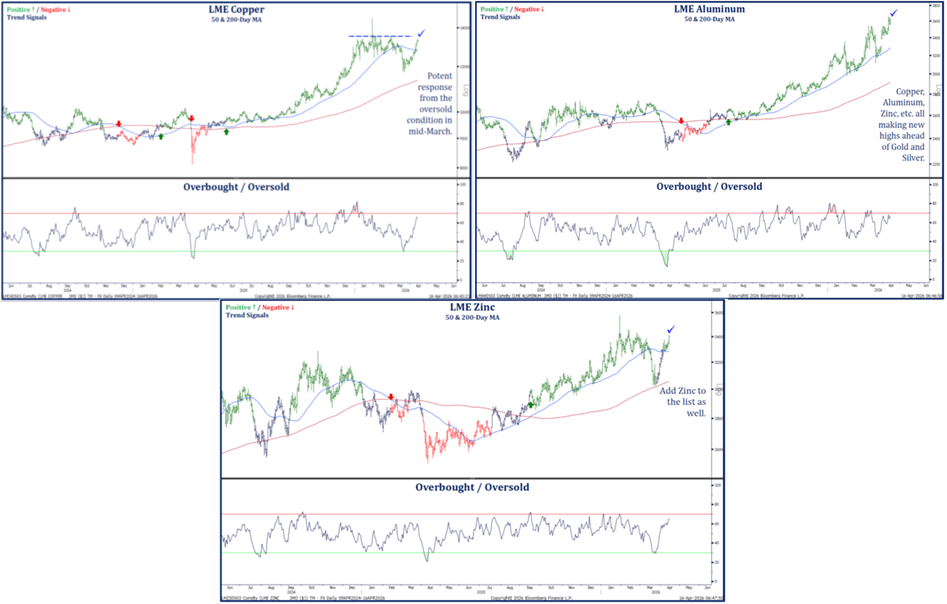
The three price charts of Copper, Aluminum and Zinc display the strong recovery following the initial sell-off of the Iran War. Industrial metals are starting to clearly outperform the precious metals (gold and silver) which have historically been a sign of expectations of improving economic growth.
Source: Strategas Research Partners
Navigating risks: Energy, AI and four key indicators
We are not naïve. It will become more difficult to insulate the global economy from the tide of persistent energy shortages. The outlook, particularly for energy-importing economies such as the EU, is more worrisome. Furthermore, in the event that current conflict is resolved in a timely and comprehensive manner, we will still be left with AI disruption, elevated valuations, and growing problems in private credit. Portfolios certainly cannot be managed on the volatility of news headlines.
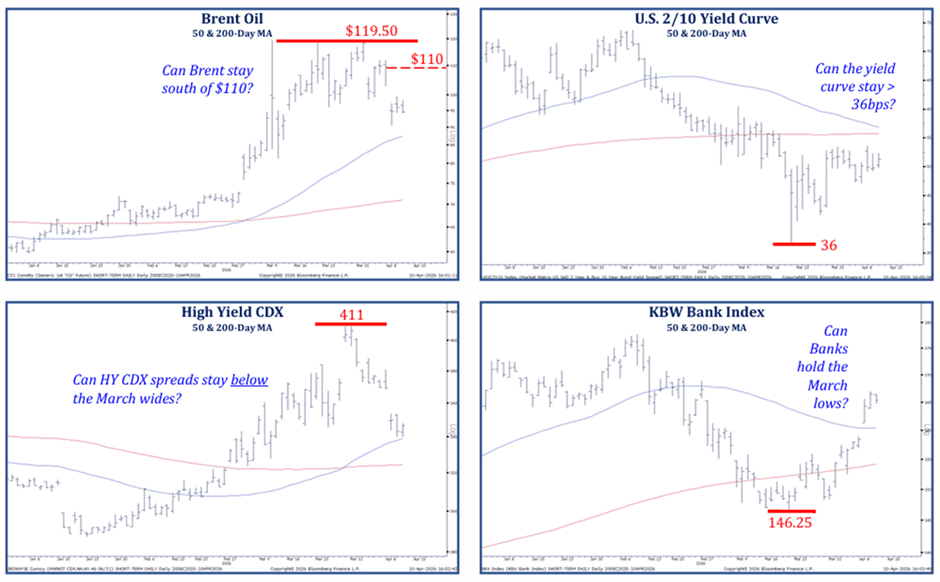
The four charts of Oil price, the shape of the US yield curve (proxy for future economic growth expectations), the High Yield Index (proxy for credit stress) and the main US Bank Index provide some line in the sand as to whether a more defensive portfolio positioning is required.
Quite simply, the levels these four indicators reached directly following the escalation of the Iran conflict have so far not been breached. In essence, they collectively signal a more constructive outlook for conflict resolution. Should these initial levels be breached, it would clearly signal a deterioration in the macro-outlook and increase the rationale for a more defensive posture.
Source: Strategas Research Partners
Portfolio positioning
The portfolio does remain well-balanced though retaining exposure to cyclically sensitive stocks that were starting to benfit from an improved global economic outlook as the year began. This did lead to losses in March but we remain constructive both on the market outlook for the remainder of 2026 as well as on the prospects for our equity investments which are selling for highly attractive discounts to the market.
We remain confident that our exposure to high quality companies selling at attractive valuations will allow for another year of strong returns in 2026.